What Is a CRM? A Small Business Owner's Guide to Choosing the Right One
If someone had asked me ten years ago what a CRM was, I probably would have stared at them with a blank look.
Today, I honestly don't know how I'd run my businesses without one.
That's because a CRM isn't just software.
It's the central nervous system of your business.
It remembers what you forget.
It organizes what would otherwise become chaos.
It helps you serve customers better.
And when it's built correctly, it actually helps you make more money.
Unfortunately, not every CRM is built with small business owners in mind.
I know that because I spent seven years using one.
What Does CRM Stand For?
CRM stands for Customer Relationship Management.
That sounds technical, but the idea is actually very simple.
A CRM is one place where you keep everything related to your customers and prospects.
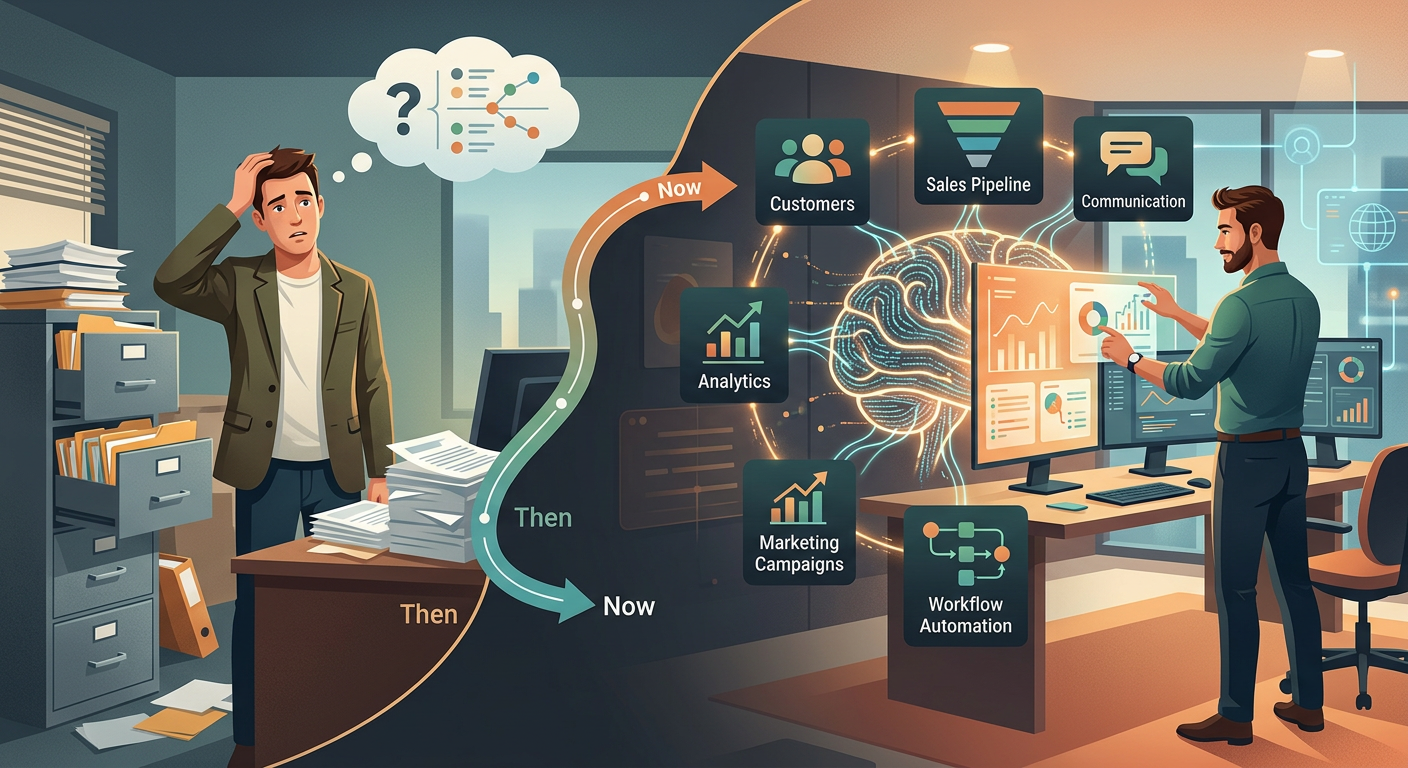
Instead of having customer information spread across:
- Sticky notes
- Text messages
- Emails
- Spreadsheets
- File folders
- Phone contacts
- Calendars
- Your memory
...everything is organized inside one system.
Think of it as the command center for your business.
Every customer.
Every lead.
Every estimate.
Every phone call.
Every appointment.
Every follow-up.
Everything is together.
Why I Started Using a CRM
Like many business owners, I reached a point where I simply couldn't keep everything straight anymore.
One customer wanted me to call them on Friday.
Another needed an estimate.
Someone else had emailed me with questions.
A referral came in from a friend.
My notebook was full.
My email inbox was overflowing.
I had reminders written on sticky notes.
I even caught myself searching through text messages trying to remember what I had promised someone.
That's when I realized something.
I didn't have an organization problem.
I had outgrown my system.
So I invested in a CRM.
For the most part, it changed my business for the better.
The Good Things a CRM Does
Over the years, I discovered why millions of businesses use CRMs every day.
A good CRM allows you to:
Capture new leads.
Store customer information.
Track conversations.
Schedule appointments.
Create reminders.
Monitor your sales pipeline.
Organize notes.
Keep your team on the same page.
View reports.
Automate repetitive work.
Those are all fantastic benefits.
And honestly, once you've experienced them, it's hard to imagine running a business without them.
Then Reality Set In
After using the same CRM every day for seven years, I started noticing little frustrations.
At first, they didn't seem like a big deal.
Then they became impossible to ignore.
One frustration stood out more than all the others.
I own more than one business.
Each business has its own professional email address.
Naturally, I wanted to send emails from the correct business.
Instead, I discovered I could only send from one email account unless I upgraded my subscription.
The cost?
Another $97 every month.
For one additional email address.
I remember thinking...
"Surely this can't be normal."
Growing My Business Was Becoming More Expensive
The more businesses I launched, the more limitations I found.
Instead of software helping me grow...
Growth meant paying more.
Need another email?
Pay more.
Need another feature?
Pay more.
Need another user?
Pay more.
Eventually I realized something.
The CRM industry had become very good at charging business owners for things they really should have had from the beginning.
That isn't how I think software should work.
What Small Businesses Actually Need
Small business owners don't wake up in the morning excited about CRM software.
They wake up thinking about customers.
Jobs to complete.
Invoices.
Employees.
Marketing.
Payroll.
Phone calls.
Family.
Running a business is already complicated enough.
The software we use should simplify our lives—not add more complexity.
In my opinion, every CRM should make it easier to:
Capture leads.
Follow up consistently.
Remember important details.
Stay organized.
Close more sales.
Serve customers better.
If it isn't helping you accomplish those things, it's missing the point.
A CRM Should Grow With You
One lesson I've learned over the years is this:
The right software should never hold your business back.
It should grow alongside you.
Whether you have one customer or ten thousand...
One employee or fifty...
One business or several...
Your CRM should adapt to your needs instead of forcing you into more expensive pricing tiers every time your business succeeds.
That philosophy became one of the foundations of Best Local Lead CRM.
Why I Built Best Local Lead CRM
People sometimes ask why I decided to build my own CRM instead of simply switching to another one.
The answer is simple.
I looked.
There were dozens of CRM systems available.
Some were incredibly powerful.
Some were beautifully designed.
Some had amazing marketing.
But every time I found one I liked, I'd eventually discover another limitation.
Or another upgrade.
Or another monthly fee.
After seven years, I finally reached the point where I thought...
"If I could build the CRM I've always wanted, what would it look like?"
That question became Best Local Lead CRM.
I wanted one platform that combined the best ideas I'd seen over the years while removing the frustrations that had bothered me as a customer.
More Than Features
When people compare CRMs, they usually compare feature lists.
I understand why.
Features matter.
But I think there's another question every business owner should ask.
"Who built this software?"
Was it built by software developers?
Or was it built by someone who actually owns businesses?
Best Local Lead CRM was built by someone who has sat exactly where you're sitting.
I've worried about following up with leads.
I've forgotten appointments.
I've searched through emails trying to find customer information.
I've paid monthly subscriptions that kept getting more expensive.
I didn't build this CRM because I wanted to start a software company.
I built it because I wanted a better way to run my businesses.
My Final Thoughts
If you're still managing customers with spreadsheets, notebooks, or your memory, a CRM can completely change the way you run your business.
It brings organization where there was once confusion.
It creates consistency where there was once chaos.
It gives you confidence that every lead, every customer, and every opportunity is being managed properly.
But don't settle for software simply because it's popular.
Choose software that understands how small businesses actually work.
That's why I built Best Local Lead CRM.
Not because the world needed another CRM.
Because small business owners deserved one that was built by someone who understands their daily challenges—and believes powerful software shouldn't become more expensive every time your business grows.
Ready to Experience a CRM Built by a Small Business Owner?
If you're looking for a CRM that was designed from real-world experience instead of boardroom theory, I'd love for you to see what we've built.
Best Local Lead CRM gives you the tools to organize your business, serve your customers, and grow with confidence—all at pricing designed specifically for small businesses.
Because that's exactly who we built it for.